
My work reflects an
ongoing effort to integrate my two polestars: first, a commitment to
environmental sustainability and scientific truth and second, my sheer delight
in working with materials to make art. I always made artwork but, like so many
of us, did not believe that it could be a viable career path. So after college
I went to -wait for it - law school.
For the first 25 years
of my working life, I was an environmental lawyer - as an Assistant Attorney
General in Massachusetts, part of one of the first environmental protection
units in the country, as a partner in a small public interest law firm, as
General Counsel to the Union of Concerned Scientists and lawyer to many
environmental groups around the country and as a partner in a large law firm.
The work was, for many
years, deeply satisfying. But as time passed, I kept stealing more and more
time to make art and, as I approached my 25th year in practice, I decided that
half of my life had been given to environmental law and the next half could be
dedicated to making art. I became a full-time artist. That was 20 years ago, as
hard to believe as I find the passage of time. Before the leap, I did worry
about changing who I “was” so completely and abruptly, but once it happened, I
honestly never had a microsecond of regret.
Washington, DC is, in
many ways, a good place to be an artist (although perhaps not the best place if
you want to be an “art star”). It is a relatively small arts community that is
easy to learn and navigate and I have found my fellow artists to be generous
and welcoming. I have shown consistently throughout the region and been
represented by several galleries over this period.
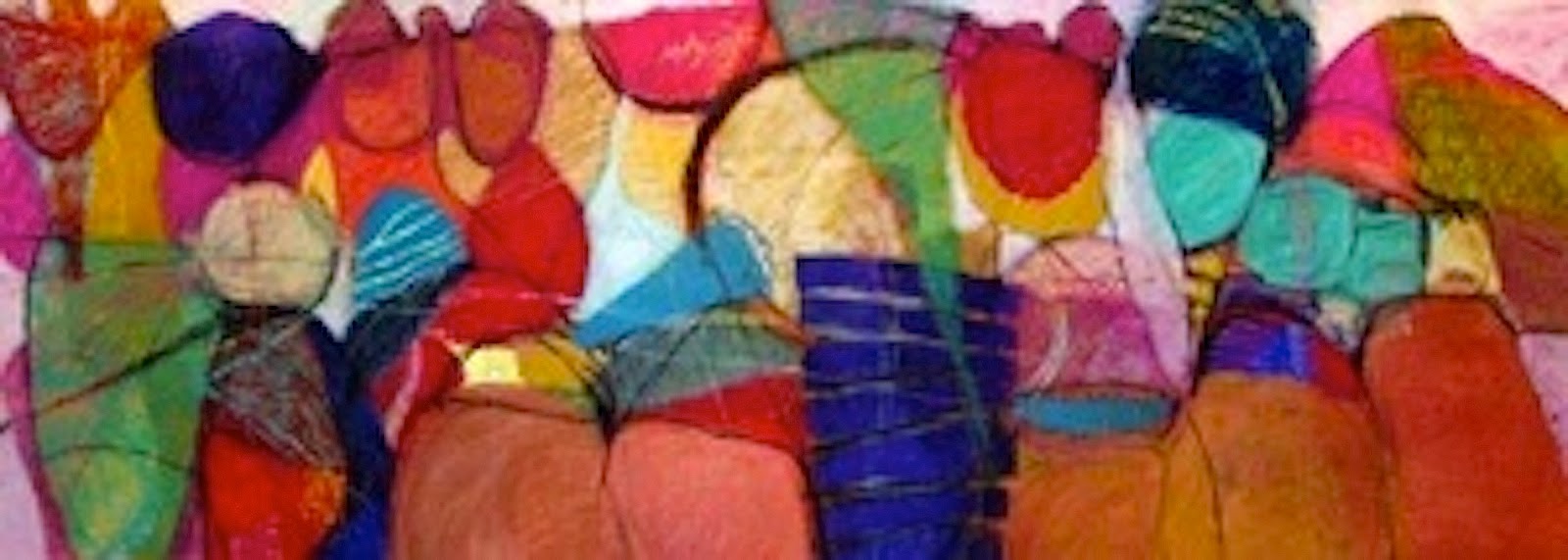
While I began as a
painter, I quickly moved to experimenting with other media. I essentially gave
up brushes about 15 years ago (although since seeing the DeKooning
retrospective at MOMA several years ago, I have been yearning to pick up a
brush again.) The first medium, after paint, that I worked in seriously was dry
pigment and oil bars, laying successive layers down and excavating among them.
I always delight in noting that one of those pieces, called “Twelve Linear
Feet” is the largest work in the collection of the District of Columbia government
shown at the Wilson Building downtown.
While the quality of
artworks is a subject of eternal debate, quantity is objectively provable! I
still make site-specific murals in these media on commission and I love to get
back to it when I have the opportunity.

I think the next
medium I became enthralled with was encaustic, a mixture of wax and resin that
is applied to a surface while molten. Encaustic creates a beguiling surface
that can be textured, colored, embedded with objects and manipulated in endless
ways. I began making smooth encaustic paintings on panels, then fairly soon,
began to physically manipulate, score, scratch, and dig into the surface.
I became interested in
the fact that wax has an “objectness” that goes beyond being applied to a surface
and hung on a wall; I worked for a couple of years, slowly uncoupling the wax
from the support until I got it entirely free. I love the resulting sculptures.

When I find a new
medium, I don’t give up the last one, I just add the new one to my repertoire.
So it was with tar. I began working with tar in 2008. I saw an artist use tar
like paint on paper and noticed that it created bleeding edges in shades of
dark brown. It was a revelation to me that tar is a gorgeous brown, not black,
and it led me to try slathering tar on boards and making images by removing the
tar with solvent. (nasty, nasty - I know!) My first show of this work was at
the Nevin Kelly Gallery in DC in 2009, called Dark Matter and it was followed a few year later by a show called Primordial Soup at McLean Project for the
Arts. I put tar aside for a while but just this summer I have come back to it
in preparation for a show in January at the Athenauem in Alexandria.

Finally, I am now
working with wire and plastic coating to make sculptural forms. You may have
noticed a strange preoccupation with nasty, smelly, probably toxic stuff. I
don’t know why this is, but I do know that I don’t have an excess of brain
cells to sacrifice. Maybe my next medium should be crayons.

I have always made
prints along with whatever else I am doing, both as a way of keeping in touch
with the satisfying immediacy of printmaking and a way to work through new
ideas.
Beginning during a
two-week residency in 2015 at the Zea Mays Printmaking Studio in western
Massachusetts, I developed a process for creating monoprints directly on
acrylic sheet. After the first week, during which time the snow outside the
studio windows grew to several feet, I thought I had failed completely, but
after a grueling period of trial and error, I began to figure out how long I
need to allow for drying between applying layers, and it started to work. The
prints have a depth and luminosity that are, in my experience, not achievable
in other media.

Now let me move from
the media to the message. My work has for many years been inspired by
biological and natural structures and, in the past 5 years or so, by the
threats posed by global climate change. I consider this to be the existential
threat of our time and am committed to doing what I can with my artwork to help
draw attention to the need for urgent action. Working with various
collaborators, I have created installations dealing with the effects of the
melting of the polar ice cap (Voyage of Discovery, American Association
for the Advancement of Science, 2014; McLean Project for the Arts, 2015), the
destruction of coral reefs worldwide (White Hot, Artists and Makers,
2016) and the climate-change caused migration of infectious diseases around the
planet (Migration of Pestilence, Otis Street Arts Project, 2017).
The wax sculptures,
called Unidentified Specimens, were
first shown in the AAAS show; they represent life forms that have been under
the polar ice for thousands of years but are now being released. For Migration of Pestilence, I began working
with wire coated in plastic to make sculptural forms. For White Hot, I
made corals from wax.

I believe that artists
should be actively engaged in the community around us. Soon after the last
election, my friend, Jackie Hoysted, and I convened a group of artists - ArtWatchDC - committed to developing ways to use the
power of visual communication to express support for true democratic values,
such as inclusion, tolerance, equality under the law, and stewardship of the
environment.
The first major
project begun by ArtWatch is One House. Over 200 artists thus far have
made 12” x 12” panels dedicated to one of her/his ancestors who came to this
country from elsewhere - whether in 1620 or last year, whether voluntarily or
involuntarily.
Participants who are
themselves immigrants have used the square for their own story. Since Native
Americans were the first inhabitants of this land, they are invited to honor
any ancestor whose life story is important to them. We have panels from artists
whose ancestors arrived on the Mayflower and from artists who arrived in this
country themselves very recently.
An underlying
structure - the “house” - has been designed and it will be completely covered
with the panels. One House will be shown in November 2017 at the Touchstone Gallery in Washington, DC.
We have designed One House to be replicable by groups
around the country, artists or not, who would like to add their voices to the
many around the country who stand for principle. Please visit our website and contact us
for more information.
This is Week 31 of 52 Artists in 52 Weeks. Thank you for
reading and sharing Ellyn’s story today. To connect with Ellyn and see more of
her work, please visit the following links:


